
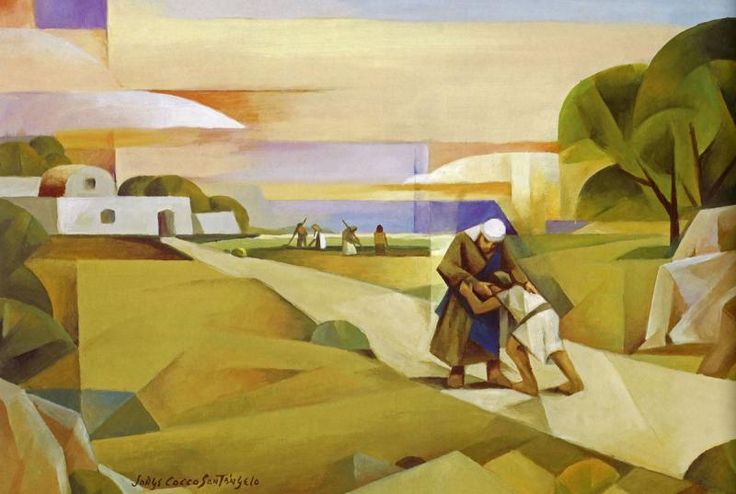
You probably know it as the parable of the prodigal son (Luke 15:11-32), but I’m not certain that’s the best title for it. We might call it the parable of the loving father, with its depiction of the extravagantly generous father who forgave and welcomed his younger son and offered him full reconciliation, even without so much as a formal apology. The father showed him what grace is like.
Or we might call it the parable of the recalcitrant brother for the way it ends, the older son maintaining his distance, holding on to his hurt and anger, letting pride and resentment and jealousy keep him from joining the celebration of his brother’s return, refusing to be reconciled with his own brother, his own flesh.
We could approach the parable from any of those perspectives, or all of them. Each character in the parable has something to teach us about our own faith. In the older son, perhaps we see in ourselves the stubborn determination that forgiveness can be allowed to go only so far if decency and order in society are to be preserved. Perhaps in him we recognize in ourselves a flicker of jealousy when an immigrant or unemployed neighbor or someone society deems the “unworthy poor” receives benefits that we’ve worked harder to provide for ourselves.
The younger son might teach us how we sometimes or too often squander our resources in life, and the gift of life itself, through carelessness or inattention, or disordered priorities, or by allowing proximate values to lure us away from ultimate values. Maybe in the example of the younger son, grace might move us to undertake some rigorous and honest self-examination, to recognize our failures and the poor choices that caused them, as the first step toward healing and the abundant life that is ours for the asking, ready to be claimed.
And perhaps the father can help us let go of the God of rules and judgment, so we might discover for ourselves the God of the psalmist, who “is merciful and gracious, slow to anger and abounding in steadfast love and faithfulness” (Ps. 86:15; 103:8; 145.8; Exod. 34:6; Num. 14:18). Maybe the father will remind us of the God in St. Paul’s version of the gospel, who is reconciling everyone, without exception, regardless of what anyone may have done wrong (cf. 2 Cor. 5:19).
That’s what might happen on the surface of the story, the part that’s easy to get to. But we start to uncover the real gem of the story, the treasure buried below the surface, when we, like the younger son, come to our senses and realize the story is not about two brothers and their father. It’s about the grace at work in Jesus and his own faith in that grace, and it’s about the grace at work in you and me, in the growth and fruition of our own faith, and how it invites us to cooperate with that grace for our healing and the healing of the world.
Scholars tell us that the parables are the best pictures we have of Jesus’ own faith in God and in God’s grace. So the parables of Jesus are also the best pictures we have of how God is working in our lives. And they are the best pictures we have of how God is inviting us to come to the party, the great banquet of heaven that celebrates our reconciliation with all those from whom we have become estranged, to cooperate with the work God is doing and to participate in it. They will show us how God offers mercy to prevail over judgment, and they will invite us into the flow of that mercy.
There are many ways to come to the party and participate in God’s living mercy. Some ways are easier and more honorable, others are more difficult and distasteful; some are suited to our natural inclinations and interests, others are contrary to both; in some we may please Christ and please ourselves, in others we cannot please Christ except by denying ourselves. So we need to count the cost even as we “press on toward the goal for the prize of the upward call of God in Christ Jesus” (Phil. 3:14) – the call to pursue spiritual maturity and eternal life through a living relationship with the Christ who lives in each of us personally and all of us together.
The end of that call – the goal of it – is that, “just as Christ was raised from the dead by the glory of [God], so we also might walk in newness of life” (Rom. 6:4), abundant life, more and better life than we ever dreamed of (John 10:10), a life not reserved for the future but available to us here and now, the experience of what Joseph Campbell called “the rapture of being alive.” That’s what the journey of faith is about, our growing in discipleship until we embody in ourselves the faith we saw embodied in Jesus, and our faith in Jesus is transformed into the faith of Jesus alive in us today.
Today we have the assurance that such grace is already at work in us, prevenient grace, grace that “comes before” and works in us even before we know it, or know to ask for it, or can begin to cooperate with it. Like a spring bulb ready to produce its flower, like the seed that holds an apple tree, like the cocoon that holds the promise of a butterfly, we are pregnant with the germ of new life that’s ready to emerge and blossom and bear fruit.
That new and abundant life is our perfect reconciliation with God, with our neighbor, and with every element of creation, not in the distant future but here and now. It’s hidden in the ordinary, as close as our every breath. It’s a celebration in which no one is left out, no matter how much of the gift of life has been squandered. Who would not come in and join in such a celebration? And who would not proclaim gratefully and joyfully the invitation to everyone you see?

 The Sauntering Pilgrim
Leave a comment