
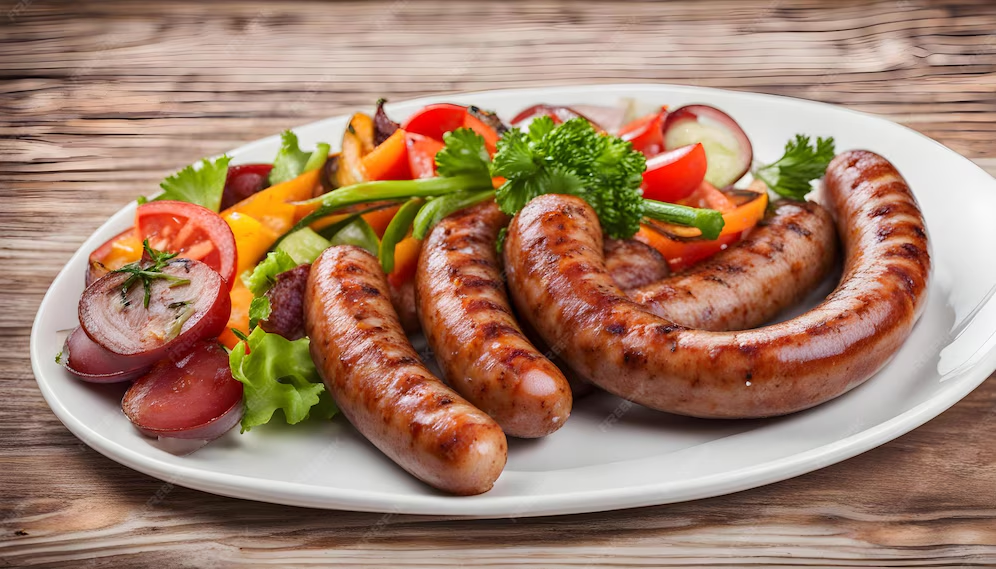
Sheryl and I have two favorite breakfasts at home, if we take time for something more than cereal. Both are quick and simple to prepare, and they make a festive start for a holiday or an ordinary day off. One starts with fresh eggs, cheese, and pico de gallo, paired with an English muffin or rye toast and some apple butter. The other is simply a plate of freshly made apple pancakes with real maple syrup. Both of them usually include sausage. Kielbasa is my favorite.
Those breakfasts are always winners. What they never include, however, is any thought of how sausage is made. Nothing can kill your appetite as quickly as watching how sausage is made, so we never talk about that, never even think about it. We simply savor a delicious breakfast, sausage and all. It’s a lot like Christmas.
The phrase about how sausage is made doesn’t come from the kitchen, nor even from the farm. It originated in the political arena, where it described the complex, frequently opaque, and often unpleasant process of making public policy. Today it has moved beyond politics to describe any process that is mysterious, unpleasant, and kept conveniently out of sight. It suggests that if you truly understand how something works, you may lose some of your innocence or idealism. It’s a good phrase to remember during Christmas.
Last week, after an Advent appetizer, we feasted on the ages-old Christmas story, retold in scripture, carols, hymns, and sacred choral and orchestral music, all of which left a delicious aftertaste that we’re still savoring. Although for many it’s a difficult day to get through, most of us experience it as a joyful day. And almost all of us tend to forget what went into the day to make it what it is. We ignore the unpleasant elements that make up this Christmas sausage.
We don’t want to linger in the parts of the story where Jesus and his family had to flee for their lives to become refugees in a foreign land; where news of his nativity sent destabilizing shock waves through the halls of government; where terrified political powerholders conspired to stave off an impending regime change; and where the widespread slaughter the of innocents was thought to be better than allowing a corrupt and narcissistic government to lose its grip on the nation.
We conveniently forget that the music of Christmas includes “wailing and loud lamentation, Rachel weeping for her children; [refusing] to be consoled, because they are no more” (Matt. 2:18). We enjoy the savor of the sausage, but please don’t bother us with the details of how it’s made.
When I entered parish ministry and had to deal seriously with the slaughter of the innocents, I was stymied. I didn’t know how it fit in the good news of incarnation. I never believed it was part of God’s plan – the bloody, officially sanctioned murder of hundreds, perhaps thousands, of infants and children. If I had found a divinely ordained place for it, I might have an easier time with what our nation’s government, and other authoritarian regimes around the world, are doing today.
But these long years later, I see that most of my real growth didn’t occur when the waters were still and the sailing smooth. It occurred when the sea was troubled and the way uncertain, when there were hard realities to be faced, hard choices to be made, and answers were elusive. The core of my spiritual life, my life as a human being, such as it is, for better or worse, did not develop during a proverbially happy childhood or a privileged education or smooth sailing through a professional career.
It occurred during a childhood spent in an generationally troubled family system, struggling to define my values in the American South during the Civil Rights years of the 1950s and early 1960s, navigating false starts and dead ends as I made my way in the world as a young adult, growing free of the regressive theology in which I was raised to find home in a more expansive faith of inclusive grace, discovering deeper values and worth in the second half of life, and settling into a life not of acquisition and accomplishment but of enduring meaning in semiretirement.
Difficult, chaotic times in life are not pleasant, and few of us would choose them, but they are strangely valuable, often more valuable than life’s easy stretches. According to our tradition, all of creation emerged from chaos. The passage from captivity in Egypt to freedom in the promised land lay through sea and wilderness, the perfect images of primordial chaos and the unknown. The closest human encounters with God are recorded in the impenetrable darkness of cloud and storm. And resurrection to new life takes place on the other side of the ultimate chaos, death.
I’m glad Jesus was born in a stable, if that’s indeed where he was born, because my soul and my life have seemed so much like a stable – poor and in unsatisfactory condition. I’m thankful he and his family began life by fleeing for safety and that he remained hidden for so long, because that taught me the value of solitude, of hiding and protecting my true self until it and the times were ready for it to be released. I’m grateful even for the political upheaval of the times in which he lived, for it taught me that out of the worst conditions and the bleakest prospects, a life of beauty and grace may grow and blossom and bear fruit. In the end, the sausage will taste pretty good, and we will realize how love – God’s quiet gift in the midst of chaos – holds us together.

 The Sauntering Pilgrim
Leave a comment