
What would you say if you were asked why you are here at Holy Trinity this morning? For the last six months, several groups of congregation leaders and members have been asking why any of us are here. We’ve been developing a Why Statement to say as realistically and clearly as possible why we are here as a congregation, and last weekend, the Church Council adopted a beta version of that statement: “We are here to nurture relationships here, near, and far so everyone may live abundantly.”
We’ll be testing that statement during the coming months to find any flaws or issues in it that need to be addressed. We’ll be asking questions like: Where are we living our Why Statement most authentically? Where are we being ambiguous or lukewarm about what we’re doing? Where are we challenged to live our why more clearly and affirmatively? How can our many and varied ministries work together and relate more effectively to the why of our being?
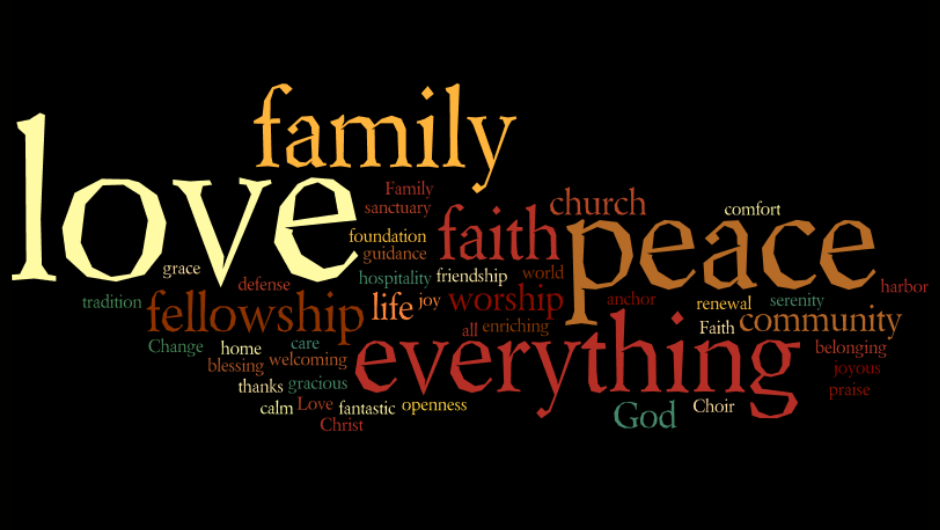
Rather than create something new, we’ve tried to craft a statement that captures the essence of the why we have embodied for the last 147 years, and already you’ve helped a great deal in that. When you were asked in 2015 and again last year to describe what HT means to you, the words you chose most often were these: love, peace, family, community, home, sanctuary, welcoming, and togetherness.
Almost invariably, your words describing Holy Trinity are about relationships. Relationships are what we have nurtured here for these 147 years; nurturing relationships is the way God has been working among us; and nurturing relationships is how we embody and proclaim the gospel today, the gospel of reconciliation, the good news of restored relationships (cf. 2 Cor. 5:17-19).
Relationships are the ground of our faith and the foundation of our hope. The land of milk and honey that God promised Israel was, in the final analysis, not a particular geography but a quality of relationship. And our vision of the culmination of history is the perfection of relationship, a holy city, the new Jerusalem no longer reserved in heaven but present on earth (cf. Rev. 21:1-4). There, here, in such relationships, we will experience the abundant life Jesus said he came to offer (John 10:10).
In developing our Why Statement, we first looked to the past. Who have we been, and what has God been doing among us? The scriptures repeatedly invite us to look to the past with gratitude. “I will call to mind the deeds of the Lord,” the psalmist wrote, “I will meditate on all your work” (Ps. 77:11f). And we’re admonished to pass the history of our faith on to our children. “But take care,” the Torah tells us, “neither to forget the things your eyes have seen nor to let them slip from your mind; make them known to your children and your children’s children” (Deut. 4:9).
But as someone said at last weekend’s Council and ministry team leaders retreat, “Look to the past but don’t stare.” Be grateful for the past but don’t be bound by it. God tells us, “Do not remember the former things, or consider the things of old. I am about to do a new thing; now it springs forth, do you not perceive it?” (Isa. 43:18f). If we don’t see the new thing God is doing, maybe it’s because we’re staring too much at what God has done. Be grateful for the past but don’t dwell in it, and don’t be bound by it. Be free to respond to the new thing God is doing today, to new relationships God is bringing to birth, to the new shape of our relationships with the world.
Several people have observed that in our Why Statement there is no mention of being Lutheran or of God. That was intentional. In Jesus’ clearest and most direct statement of why he came, he said, “I came that they may have life and have it abundantly” (John 10:10). He didn’t mention the Jewish faith, which was undoubtedly important to him, and he didn’t mention the divine reality that his whole life embodied. Instead, he spoke of life, abundant life.
When Jesus, in his own “why statement,” left out any mention of his faith or of God, I believe he did so because he didn’t want to let the gospel he proclaimed get tangled up with or obscured by debates about religion or theology or the meaning of life. Those pitfalls were all too common in his day, and they still are. That’s why I believe it’s important to leave them out of our public interface with the world. They too easily lead to disputes in matters about which we can only speculate, and abundant life is different for every person.
Instead of digressing into tradition or theology or meaning, Jesus wanted to stay focused on the quality of life he called “abundant.” He didn’t talk about a so-called “spiritual” life, and he rarely mentioned anything about what happens after death. His message was about a quality of existence to be experienced here and now in what St. Paul called our “sleeping, eating, going-to-work, and walking around life” (Rom. 12:1 The Message), ordinary life in all its fullness.
The abundant life Jesus offered is something Joseph Campbell called “the rapture of being alive,” a quality of life in which our experiences in the purely physical world resonate deeply with our innermost being and reality. It’s a quality of life in which all the needs of human existence are met, from the most basic need for safety and survival to the higher needs for self-esteem and realizing one’s full potential.
And right in the middle of those needs is the need to be loved, the need for belonging, the need for authentic relationship. Our higher needs for self-esteem and fulfillment depend upon having our needs for healthy human relationships satisfied. And that’s why we are here. We are here to nurture relationships here, near, and far so everyone may live abundantly.


 The Sauntering Pilgrim
Leave a comment