
It’s been said, people don’t resist change, people resist being changed. Change is fine when I initiate and control it, or it’s okay when I participate in its natural, slow evolution. Sudden change that’s beyond my control is a different matter.
That lesson was reinforced last week when Sheryl and I learned a favorite restaurant of ours had closed. We had no warning; we just drove up, saw the building was dark, and read the sign offering the furnishings and equipment for sale. Nina’s wasn’t a great restaurant, just a pretty good one, but it had the best kosher hot dogs I’ve ever eaten, Sheryl loved its Texas burgers, and we both loved the staff. Now our habits need to change, and we have to find a new place, knowing that the new we find will be different from what we have known.
The closing of Nina’s gave us a tiny taste of how Israel must have felt when they arrived in the promised land only to discover their regular restaurant had closed and life was more different than they expected. The manna God provided to sustain them during their wilderness years ceased without warning, and they faced sudden change beyond their control. They needed to find a new source of nourishment (Joshua 5:9-12).
It couldn’t have been an easy transition. The sustaining manna had grown boring – in fact, it sparked a barely avoided insurrection during the journey (Num. 11:4-6) – but at least it was familiar and dependable, so it was to some extent comfortable, and it came to define their existence. When they reached their destination, where life promised to be as good as it could be, the manna God provided from heaven suddenly stopped. Without warning, they had to pivot and depend on a new and unknown source of nourishment.
They found it when they ate the crops of their new homeland, the land of Canaan. And what a change it involved! The manna that had sustained them for their lifetime had been provided freely and scattered at their feet each night. All they had to do was gather it each day.
Now in their new home, they had to work much harder. They had to plow the ground, and sow seed, and pull weeds, and defend against insects and wildlife, and finally harvest the crop if they were to feed themselves. There were new plants to discover and cultivate and new techniques to learn if they were to sustain life in a land they had not known before.
What a perfect metaphor for this life we live! When we are children, parents provide the food we need; it appears mysteriously and freely on our plates each day. In adolescence, we yearn for freedom from parental constraints. When we gain that freedom as adults, we discover a new and unexplored geography where we have to work a lot harder than we expected to provide what we need for a full life. And in the end, on the far side of all that work and adaptation, if we’re attentive and diligent, we find our cup overflows with blessings we could not have predicted.
It’s also a perfect metaphor for the spiritual journey. As spiritual children, we are nourished and sustained by the examples of those close to us: parents, teachers, trusted neighbors, mentors, perhaps even a pastor, rabbi, or imam. As spiritual adolescents, we yearn for the freedom of an original, authentic relationship with the source of life, so we push beyond the boundaries of what we have known and begin the long journey through a wilderness of choices that will shape our lives further. As spiritually maturing adults, we discover new options and new possibilities that we must learn to cultivate and harvest if we are to enjoy a truly abundant life.
And it’s a perfect metaphor for us as a congregation here at Holy Trinity. In our formative years, we learned how to be a church, nourished by the teaching and example of our forebears and sustained by their tradition. Along the way, we pushed boundaries, growing and maturing spiritually as we found new ways to be the church as each generation gave way to the next.
Today we are in a new Canaan, a new cultural and spiritual geography, where old ways of being the church no longer suffice in our meeting with the world, where old manna, old ways of being nourished in our faith, no longer suffice for this new time and place. We need to look around us with clear eyes and explore this new landscape in which we live, to discover what crops are here to be harvested now.
We know the gospel, and we still have much to learn about how to embody it in our time and place. We know the gospel, and we still have much to learn about how to bring it to bear in the world that surrounds us today. We know the gospel, and we still have much to learn about how to make it known to others in new language and images. We know the gospel, and we still have much to learn about how to make it relevant to the questions people ask and the challenges people face in our neighborhoods and workplaces and marketplaces.
We are called to ministry as individuals, as a congregation, and as a community of congregations, to share with those near to us the good news of what God began in Jesus and continues in us. As we continue to develop our Why Statement, our understanding of why we are here, let’s continue together to open ourselves to the Spirit of God through increased commitment to the traditional disciplines of personal and corporate scripture study, fellowship with one another, breaking bread together in Eucharist and in community meals, and prayer in all its forms (Acts 2:42). We may yet discover what it’s like to feast in the new and promised land where God has brought us.

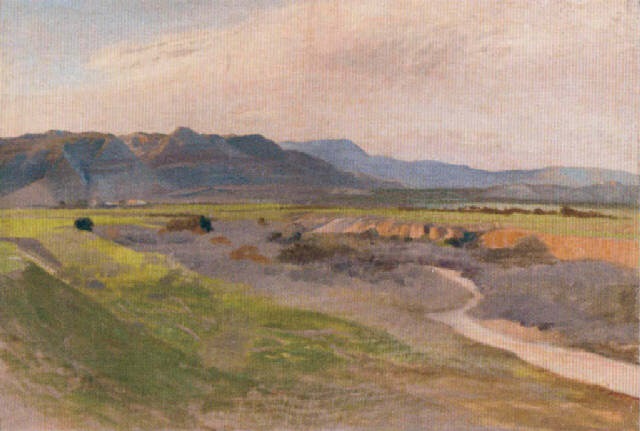
Illustration: The Plains of Jericho, oil on canvas, by Gustav Bauernfeind (1848-1904)

 The Sauntering Pilgrim
Leave a comment