
For some, the work of Christmas ended when they put the tree on the curb and the decorations back in their boxes and finished their gift returns. But for those who take the gospel of Jesus Christ seriously, for those who take the name of the Lord – Christian – not in vain but authentically and faithfully, the real work of Christmas continues. It’s the work of determining how we’re going to live in light of the gospel proclaimed by the Messiah who has come.
In Luke’s gospel, Jesus begins his ministry with a short sermon to his hometown congregation (Luke 4:16-21), a kind of inaugural address. In it, he outlines his agenda for life: “to proclaim the year of the Lord’s favor,” a time when God’s justice and mercy pours out on all people and true peace prevails on earth. He called all people to make his agenda theirs and to shape their lives according to that justice and mercy.
Sounds good, doesn’t it? Who doesn’t want peace? Who doesn’t want God’s justice and mercy to prevail? And who doesn’t want to be involved in bringing God’s peace, justice, and mercy to the world? Well, a surprising number of people don’t. The rich and powerful and those who support them don’t. When King Herod and those who shared his power learned that a new messiah had been born to replace Herod as ruler, they were frightened (Matt. 2:3), and they responded with a pogrom in which all the children who were born at that time were slaughtered (Matt. 2:16-18).
The resistance to Jesus and his gospel continued when he began his ministry. When we recall how Jesus proclaimed the year of the Lord’s favor that day in Nazareth, we also recall what happened next. At first, everyone was pleased and “spoke well of him” (v. 22). But when he explained what his gospel meant in practical terms, the adoring crowd became a mob bent on murder. They drove him out of town and tried to throw him off a cliff; God knows how he escaped (vv. 28-30).
Resistance to Jesus and the gospel he proclaimed was not limited to Palestine in the first century. It continues today wherever people have grown comfortable in their power and wealth and want to preserve it. When they’re confronted with the gospel and its implications, they still want to drive the messenger out of town and silence anyone who brings good news.
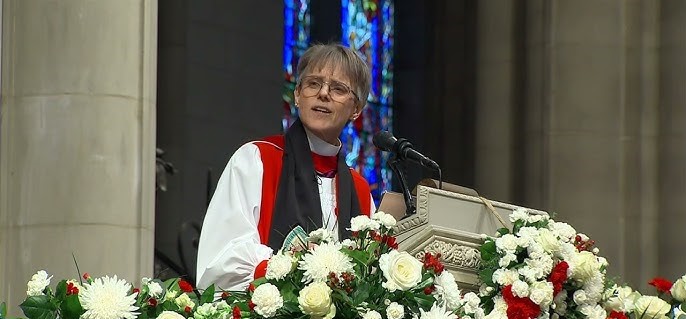
In her sermon during the National Prayer Service last week, the Rt. Rev. Mariann Budde, the Episcopal bishop of Washington, D.C., proclaimed the gospel. Then she turned to President Trump and asked him to put the gospel into practice, pleading with him “to have mercy upon the people in our country who are scared now,” “some who fear for their lives”: to be merciful as God is merciful (Luke 6:36). She asked him to fulfill the biblical mandate to show hospitality to the strangers and sojourners among us, “for we were all once strangers in this land.” And she asked that “God grant us the strength and courage to honor the dignity of every human being, to speak the truth to one another in love and walk humbly with each other and our God for the good of all people.”
Mr. Trump ignored the gospel and described her as “a Radical Left hard line Trump hater” who was “nasty in tone,” saying her statements were “inappropriate” and that she “is not very good at her job.” A writer in the Palm Beach Daily News accused her of using her sermon “to dress down, berate and virtually ambush our new president for his politics.” Republican Representative Mike Collins of Georgia wrote that she “should be added to the deportation list” (she’s from New Jersey). And it wasn’t long before she started receiving death threats.
Bishop Budde accounted for her faith and spoke of its implications with “gentleness and reverence” (1 Pet. 3:15). She was met with rejection and anger from the same kind of mob that wanted to drive Jesus out of town and throw him off a cliff, the same kind of mob that later would crucify him.
When we, in our baptism, commit ourselves to follow Christ Jesus as our Lord, we commit ourselves to live in “the year of the Lord’s favor.” We commit ourselves to make Christ’s good news and agenda ours and to shape our lives according to God’s justice and mercy – with gentleness and reverence, yes, and with unflinching boldness and faithfulness to the gospel.
For us, the work of Christmas is not about exchanging gifts, feeling good about giving money to charities, putting away the decorations until next year, or writing thank-you notes. It isn’t even about telling others the story of Christmas. It’s about embodying the story of the Messiah who came. It’s about being and becoming the good news that with the birth of Jesus Christ became and still becomes flesh and lives among us, full of grace and truth (John 1:14).
The real work of Christmas is the work described by theologian and civil rights activist Howard Thurman:
“When the song of the angels is stilled,
When the star in the sky is gone,
When the kings and princes are home,
When the shepherds are back with their flock,
The work of Christmas begins:
To find the lost,
To heal the broken,
To feed the hungry,
To release the prisoner,
To rebuild the nations,
To bring peace among others,
To make music in the heart.”
When we do that work faithfully, bringing God’s justice and mercy into the world, the powers of the world, like Mr. Trump, will tremble and push back with all they have, but like St. Paul, “we may be afflicted in every way, but not crushed; perplexed, but not driven to despair; persecuted, but not forsaken; struck down, but not destroyed; always carrying in the body the death of Jesus, so that the life of Jesus may also be made visible in our bodies” (2 Cor. 4:8-10). We will know “the peace of God, which surpasses all understanding” (Phil. 4:7), and we will make music in our hearts, music that will reverberate throughout the world. ▪


 The Sauntering Pilgrim
Leave a comment