
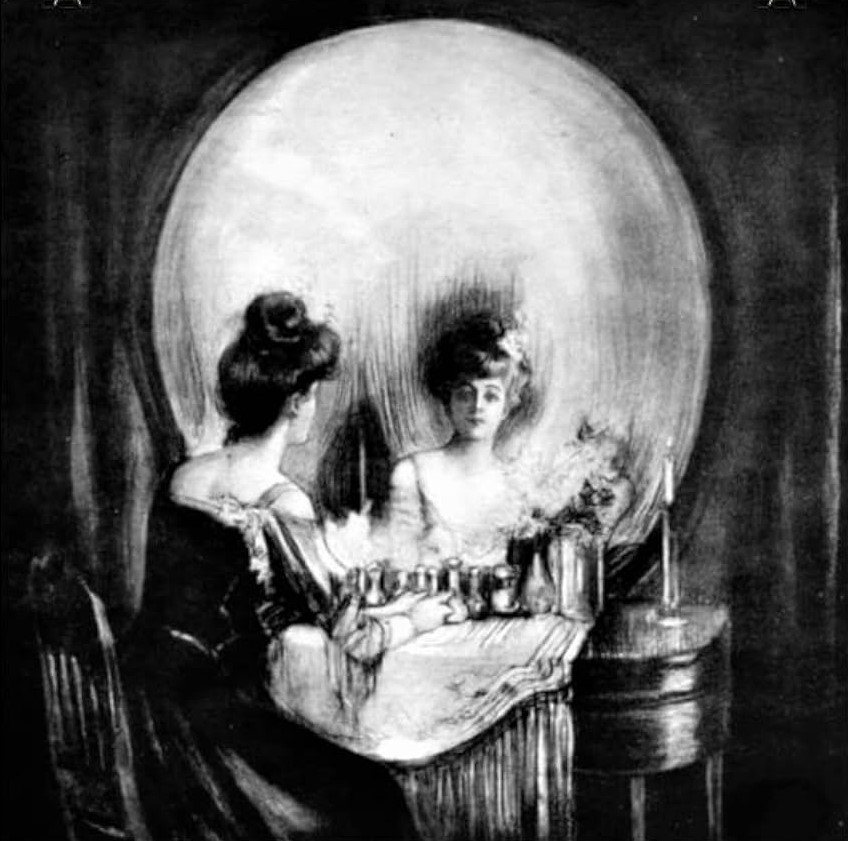
You may have seen artist Charles Allan Gilbert’s depiction of an elegant young woman seated at a vanity, admiring herself in the mirror. With a slight shift of perspective, the image becomes one of a human skull. Gilbert’s art is more than a trick for our eyes or a comment on vanity. It’s also a visual pun on our inability to see truly. What we believe we see is not always what’s there, or it’s not all of what’s there. We usually see what we’ve been trained to see, what we expect to see.
About our way of looking at life, St. Paul observed, “we see things imperfectly as in a poor mirror” (1 Cor. 13:12), or in Eugene Peterson’s paraphrase, “We’re squinting in a fog, peering through a mist.” Annie Dillard (in Pilgrim at Tinker Creek) noted we look at creation as if through a keyhole, seeing only about thirty percent of the light that comes from the sun. Most light is infrared or ultraviolet, which many animals can see, but not us; what we see, our nerves edit for the brain, leaving out more than they let in. But sense impressions of one-celled animals, Dillard points out, are not edited for the brain, which means only the simplest animals perceive creation as it is.
That may help explain why Nicodemus had such a hard time understanding what Jesus said about the need to be born “from above” in order to see the kingdom of God (John 3:1-10). Nicodemus was anything but simple; he was well educated, deeply formed by his culture, fully immersed in the dominant theology of his day, and his cup was too full to hold anything more or different. He tried to comprehend what Jesus said, tried everything he knew except changing the perspective from which he tried to approach God.
Some people read the story about Jesus curing a man born blind (John 9:1-12) as a story about a physical cure: a blind man was given the ability to see. However, it takes on a deeper, richer meaning if we read it as a metaphor for a sighted person who, with a slight shift of perspective provided by his encounter with Jesus, comes to recognize something about life that’s always been present but unperceived.
This business of seeing or not seeing has a central place in something Paul wrote, that “if anyone is in Christ, there is a new creation: everything old has passed away; see, everything has become new” (2 Cor. 5:17). If someone is “in Christ,” does the old creation – the one we’re familiar with, the world we know – objectively pass away and become new? Or does our perception change, our way of seeing, so that creation remains objectively the same but subjectively appears to be new and different?
Maybe that change in perception is what John experienced when he saw the new Jerusalem coming down out of heaven from God (Rev. 21:2). Maybe their old perspective is what Isaiah knew would keep Israel bound in their brokenness: listening but unable to comprehend, looking but unable to understand (Isa. 6:9). Maybe their old perspective is what Jesus knew would keep people from seeing the kingdom of heaven that was spread all around them and that remained unseen (Gospel of Thomas 113). Maybe their old perspective is what kept the invited guests so immersed in the concerns of daily life in the world, they missed the call to sit down at the great banquet prepared for them and that was already being served (Luke 14:15-24).
There’s no telling how such a change in perception happens, how we suddenly come to see what’s been right under our noses all along. And there’s no predicting when it might happen. It usually sneaks up on us like a thief in the night (1 Thess. 5:2). At the time, you may not even know that it’s happened, but you wake up to the fact that your life has changed, and you discover you can see things you can never unsee and that you’ve walked through a door you can never walk back through.
It happened to me when I was working in the publishing business. While deciding about a job change, I made a commitment to get involved in the church again and try to see where God might be leading me. It was as simple as that. Three years later I awoke to the realization that I was going to seminary. I didn’t decide to go, I just realized the decision had been made, and of course there was nothing else to do but go. It was an insight in the making for three years, probably longer. The way I saw my life changed in a way I couldn’t have made happen or even anticipated, like seeing creation made new.
Moments of such insight and clarity come rarely, and we can never force them, but we can invite them in an exercise I call “prayerscaping.” Like landscapers work harmoniously with their natural surroundings, prayerscapers seek harmony with God’s will. Learning to view creation through God’s eyes and live in harmony with God’s will is the real purpose of prayer. We don’t pray to bend God’s will to ours; we pray to bring us and our actions into harmony with God’s will.
Find a place to sit for fifteen or twenty minutes – longer if possible – and observe what’s going on around you. It could be a coffee shop, a retail district, a busy street corner, a public park, a quiet corner of your back yard, or a window looking out on your neighborhood. And as you observe, repeat this simple prayer in your heart: “Lord, help me see what you see.” Jot down a few words or phrases to describe your thoughts or feelings, and follow the promptings of the Spirit within you.
You may remember the dialog between Alice and the Cheshire Cat in Through the Looking Glass. Alice was asking for directions.
Alice: “Would you tell me, please, which way I ought to go from here?”
The Cheshire Cat: “That depends a good deal on where you want to get to.”
Alice: “I don’t much care where.”
The Cheshire Cat: “Then it doesn’t much matter which way you go.”
Alice: “. . . So long as I get somewhere.”
The Cheshire Cat: “Oh, you’re sure to do that, if only you walk long enough.”
As with Alice looking for directions, what you see in life depends a great deal on what you look for, on whom you ask for instruction, and on how long you’re willing to look for it. As the psalmist advised, “Commit everything you do to the Lord. Trust in him, and he will help you. Be still in the presence of the Lord, and wait patiently for him” (Ps. 37:5, 7 NLT).

 The Sauntering Pilgrim
Leave a comment