
Picture the parent, arms akimbo, confronting the young child. “Have you been eating chocolate?” The child, face covered with chocolate and a “Who, me?” expression, answers, “No, not me!” Now intensify that scene several hundred times, and imagine God calling to Adam in the garden, “Where are you?” and Adam, knowing he’d been caught, trying to hide from God. “I heard the sound of you in the garden,” he said, “and I was afraid, because I was naked; and I hid myself.” And God said, “Have you eaten from the tree of which I commanded you not to eat” (Gen. 3:9-11)?
Adam not only tried to hide his condition from the One who already knew all about him, including where he was. He also tried to hide from his responsibility for his condition, shifting blame elsewhere, even to God. “The woman you gave me made me do it.”
We do that, don’t we? – try to find a reason “out there” for our condition in life. Like when the disciples, walking with Jesus, met the man blind from birth and asked, “Rabbi, who sinned, this man or his parents, that he was born blind” (John 9:1-2). There must be a reason why bad things happen, somewhere to point a finger, someone or something to blame.
Before time was counted as anything but moons and seasons, a sacred story arose that life is bad because we must have done something bad. We must have disobeyed God. “Have you eaten from the tree of which I commanded you not to eat” (Gen. 3:11)? Yes, we did, so we were expelled from paradise; we came to live among thorns and thistles, earning a living by the sweat of hard labor and bearing children in pain, until we finally work ourselves into the ground from which we came (Gen. 3:14-19).
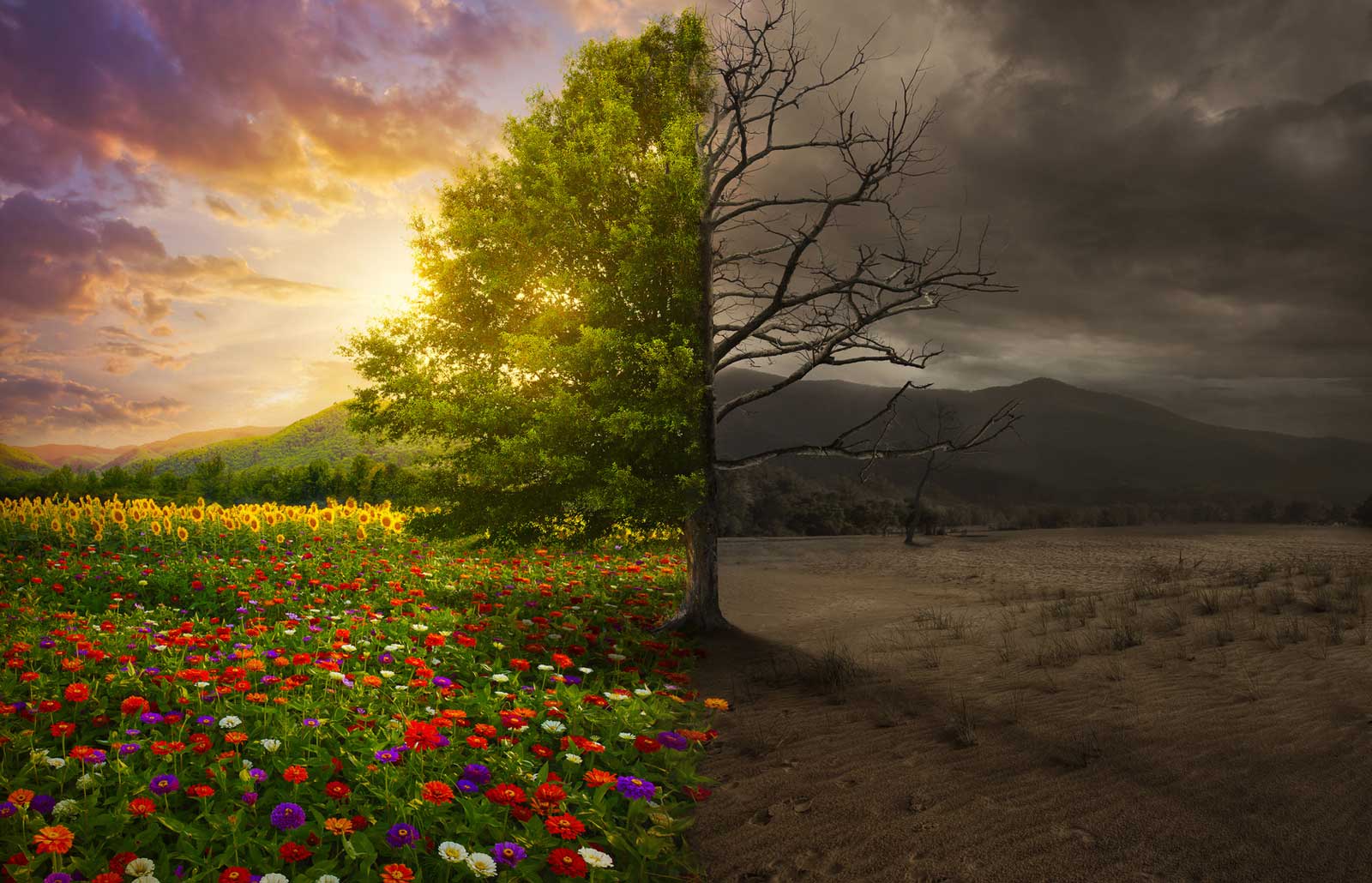
But suppose it’s not disobedience that causes hardship and suffering, but the way we view life that causes suffering. Suppose suffering is not punishment for breaking sacred rules and doing what God told us not to do. Suppose instead suffering is the result of viewing creation as divided into good and evil, two opposing and irreconcilable forces at war with each other.
Jesus told us that “if your eye is healthy, your whole body will be full of light; but if your eye is unhealthy, your whole body will be full of darkness” (Matt. 6:22-23). But there’s a better way to translate the original Greek. “If your eye is single, if you see all things as one, undivided, your whole body will be full of light; but if your eye is evil, if the way you see things burdens you with suffering, your whole body will be full of darkness.”
We live a hard, divided life in a hard, divided world because we see it as hard and divided – we’ve come to separate good and evil. But if we see things as having integrity, if we see all of life as being whole and undivided, our hearts will be enlightened. That may seem like the kind of idea theologians like to wrestle with, and you may wonder what it has to do with our day-to-day life in this world. So let me tell you something I’ve learned from my wife Sheryl, who is a master gardener.
Our neighbor has a lawn that looks as if it might be featured in Better Homes and Gardens, a smooth carpet of green, carefully trimmed and weeded. They have it sprayed regularly by a lawn service to keep it looking that way. Our lawn is something else, full of dandelions, creeping Charlie, yellow wood sorrel, at least two kinds of clover, some tiny daisy-like flowers, and lots of other things I can’t name. And underground, there are worms, lots of big, fat earthworms, along with an assortment of grubs, potato bugs, spiders, and many other creatures.
Once upon a time, I liked lawns like our neighbor has. Now I’ve learned to appreciate the life our lawn supports. The way our neighbors treat their lawn kills most things of nature – including, with a high-enough level of exposure, pets and people. The way we treat our lawn produces a rich, healthy biodiversity that supports life of many kinds below ground, at ground level, and above ground. Plants and animals our neighbor labels “bad,” we’ve learned have a productive, necessary place and role to play in the larger ecosystem.
Maybe all of life is like that. Experiences and realities that are hard for me to understand turn out to have a proper place and serve a proper purpose in the whole. I may not understand that place and purpose, but I’m learning to trust the integrity of it all. Like I trust the pollinators that visit our lawn to produce one out of every three bites of our food, including fruits, vegetables, chocolate, coffee, nuts, and spices. I’m learning to see the wisdom in what St. Paul wrote, “that all things work together for good for those who love God, who are called according to his purpose” (Rom. 8:28) – “that every detail in our lives of love for God is worked into something good” (The Message).

 The Sauntering Pilgrim
Leave a comment