
Change! It’s hard to live with because it’s often painful, and when change is big and sudden, it can be very painful. And you can’t live without it because change is part of life, and to grow is to change. You can’t grow into the fullness of life tomorrow if you’re stuck living in the past, unchanging: you’ve got to embrace change and dance with it creatively. Remember how Jesus told Nicodemus that you can’t even see the kingdom of God, the abundant life Jesus offered, much less enter it, without changing your entire perspective on life, without being “born from above” (John 3:1-10).
Change is not new to the church; the church was born in a cauldron of change. We are here to live as examples of the abundant life that’s possible through transformative change and to serve as spiritual midwives as others undergo similar change. Change can be life giving. But change can be destructive when it leads to division.
In our scriptures, Paul begins his first letter to the Corinthian church by admonishing its members not to let differences lead to division (1 Cor. 1:10-17; 3:1-23). And in today’s reading from the book of Acts (1:15-17, 21-26), the original apostles seem especially concerned, in choosing a replacement for Judas, to avoid the divisions that have plagued the infant church since its beginning. They want to know the heart of the new guy they’re choosing, as God knows his heart, and whether he will bring continuity or change, so together they can effectively continue what Jesus began.
To effectively continue what Jesus began – that’s why the Corinthians and this congregation and any congregation is here today, so we and others can enjoy more and better life than we ever dreamed of having (John 10:10). That’s the direction in which the Spirit moves, and division within the body of Christ is one of the major frictions that slows down the Spirit’s movement. So when change threatens to divide us, what can we do to remain good stewards of the gospel and continue God’s reconciling ministry in Christ (2 Cor. 5:16-20)?
First, we need to remember that differences are necessary. Paul writes that there must be factions among us – small, organized groups of dissenters – so it will become clear who is genuine (1 Cor. 11:19). Differences, disagreements, and factions serve to test and clarify our faith and bring us closer to the truth. We need to recognize them as opportunities to listen deeply and prayerfully to one another. Part of how I define listening – it’s also part of how I define prayer – is letting something not yourself in on its own terms. That means lowering my filters of preconception and prejudice so I can hear the other person truly and authentically. Only then can I approach the truth.
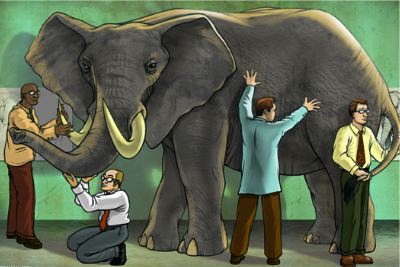
You may know the poem about six blind men who try to describe an elephant. The first touched the elephant’s side and said it was like a wall; the second touched its tusk and thought it like a spear; the third felt its trunk and believed it was like a snake. One after another, all six formed opinions based on their own limited experience. So they debated loud and long, each holding firmly to his own opinion – each of them partly right and all of them wrong. Our different experiences of God and what our differences mean for our life together, by themselves are all wrong, but together they bring us to a more complete experience and understanding.
The second thing we can do to participate in God’s reconciling ministry is focus not on superficial things but on deeper things. The first apostles chose a replacement for Judas by praying for God’s guidance based on what God knew was in everyone’s heart. When differences lead to division, it’s a sign we’re not looking deeply enough into our relationships, that we’re focusing on the surface when we should be looking into our hearts.
We are going to hold many different beliefs as Christians about worship, morality and ethics, and the practice of our faith. What’s important is not that we believe alike but that we love alike. Are our hearts open to all regardless of belief or religious affiliation, politics or social connections, level of income or education, or any other category. The final question is: do we value one another truly? Do we view the other person and his or her welfare, whoever he or she may be, as essential to our own wholeness? And do we act toward that person accordingly?
When the early apostles chose Matthias as the successor to Judas, they based their choice on God’s guidance according to what God knew was in Matthias’s heart. It’s an invitation to us – and a challenge – to base our relationships with each other, and with everyone we meet, not on what we see on the surface nor on whether we believe alike but on the deep human bond that unites us as children of God.

 The Sauntering Pilgrim
Leave a comment