
With just four words, the CEO of the Boeing aircraft company taught corporate executives everywhere a powerful lesson about leadership. And he taught all of us a powerful lesson about our faith, one that’s especially appropriate for Maundy Thursday.
Recent years have not been good for Boeing, so Dave Calhoun was hired four years ago to fix a growing list of problems, including a pair of fatal 737 crashes. Then there was the recent Alaska Airlines incident involving a door plug that blew off during a flight. As a result, Calhoun announced he is stepping down, along with the company’s board chairman and the head of its commercial aircraft business.
Addressing the company’s employees, Calhoun called the Alaska Airlines incident a “watershed moment for Boeing” and said the company “must respond to this accident with humility and complete transparency.” In those four words, “humility and complete transparency,” there’s an essential lesson not only for corporate leaders but for everyone who professes to be a follower of Jesus.
The wise way to respond in a crisis is with “humility and complete transparency,” but it’s not the typical way leaders respond. The usual way is to go on the defense to minimize the damage, to circle the wagons, to put up a wall and push back. It’s counter-intuitive to be humble and transparent, to set aside your defenses and be open to the fact that you’re accountable for what’s happening. Yet that’s what Calhoun did, and it may be the single most important thing he could have done to restore the credibility of the company in the face of their crisis.
And what of our own crisis? “These are the times that try men’s souls,” Thomas Paine wrote at the beginning of the American Revolution. “The summer soldier and the sunshine patriot will, in this crisis, shrink from service to his country; but he that stands it now, deserves the love and thanks of [all]” (The American Crisis, no. 1, 1776). These are times that try our souls and our commitment to the faith we profess, and today in this nation, we face our own social and political crisis.
It’s also a crisis of faith, and it’s testing us to see how committed we are to the ministry of reconciliation which God has entrusted to us (2 Cor. 5:18-19). Today we are living an increasingly broken, divisive, and fragmented life, what the Hopi language calls Koyaanisqatsi, life out of balance, a way of life that calls for a different way of living. Will we prove to be sunshine disciples of Jesus, engaged in reconciliation only when the season is soft and the way is easy? Having supped at the table with Christ, will we step into the dark to betray him? Or will we accept accountability for our ministry of reconciliation and stand as vulnerable yet faithful witnesses against those whose aim is to seize power by dividing us and setting us against one another?
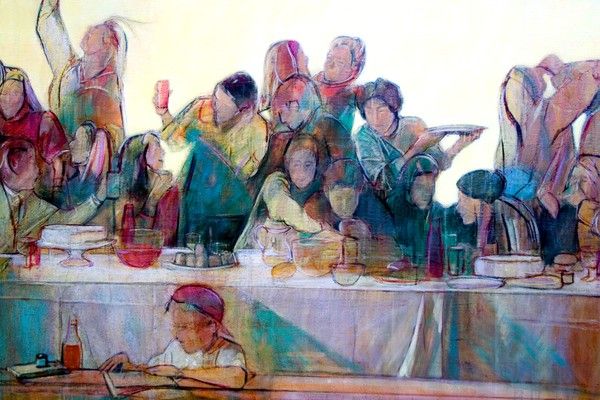
There are many ways for us to put up a wall to defend ourselves from the risk of faithful involvement in the crisis that’s breaking around us. We may choose not to get involved, to retreat within the walls of the church, to treat the memory of Jesus’ last supper as little more than a dramatic relic of our faith foundation. We can watch his final meal, and all that follows, play out like we might watch a performance at Shea’s Theatre, one that moves us, perhaps deeply, but that allows us an objective and comfortable distance from the action.
In The New Yorker magazine years ago, E.B. White described a cowboy who commuted by plane between New York and Chicago. The cowboy’s job was to throw steers in the rodeos of both cities. The steers didn’t need to be thrown, but he threw them anyway to entertain the audience. Then, when he’s thrown the steer, White wrote, “The cowboy rises from the head of the fallen animal, dusts the seat of his pants, walks stiff-legged to the waiting airliner. The spectators, yearning for the open West and its herds of cattle on the ranges, rise from their mezzanine seats, stiff-legged, dust off their unfulfilled desires, walk to the exits.”
Time after time we dramatize Jesus’ last meal with his disciples. We break bread and share the sacramental cup; we read about the washing of feet; then we go home to await Easter morning. But I wonder how often our experience is like that of the spectators who watched the cowboy at that rodeo. How many of us yearn for the experience of those early disciples, and for the fullness of life they shared, but keep it safely confined to the scriptures and tradition? Then at the end of the service, we rise from our seats, dust off our unfulfilled desires, and walk stiff-legged to the exits.
The response that makes us whole is not one of mood or whim or waiting for the right time. It’s one of choice, the kind of choice Aldous Huxley described in his poem “Orion” (The Cicadas and Other Poems [London: Chatto & Windus, 1931], 39).
The choice is always ours. Then let me choose
The longest art, the hard Promethean way
Cherishingly to tend and feed and fan
That inward fire, whose small precarious flame,
Kindled or quenched creates
The noble or ignoble [persons] we are,
The worlds we live in and the very fates,
Our bright or muddy star.
The choice is ours, always ours. And especially today, the choice is yours. ▪

 The Sauntering Pilgrim
Leave a comment