
The young rich guy driving his new Ferrari Spider through Vermont pulled up at a traffic light, and an old Vermonter – dressed in Bean boots, corduroys, a threadbare flannel shirt, and big red suspenders – pulled up beside him on a Moped and started admiring his car. He allowed that the car must be pretty fast, and he started talking about how he had souped up his Moped so it could go pretty fast, too.
When the old guy leaned into the Ferrari for a better look, the young guy had enough. “I’ll show him,” he thought, and when the traffic light changed, he floored it, leaving the old Vermonter in the dust. Then, a half mile or so up the road, he looked in his rearview mirror and saw a speck approaching him. The speck grew larger, caught up with the Ferrari, and started to pass it by. It was the old Vermonter on his Moped, a look of utter excitement on his face as he waved at the younger man before speeding ahead.
A quarter mile or so ahead of the Ferrari, the Vermonter turned around and headed back toward the Ferrari, flew past it again, and turned around for another approach. This time, however, the Moped slammed into the back of the Ferrari. The young guy stopped the car, got out, and went back to see if there was anything left of the old man and his Moped. The old man was barely alive. Before admiring the surprising speed of the Moped, he asked the Vermonter if there was anything he could do to help him. The old man slowly opened his eyes, looked up, and whispered, “Ayup. If you don’t mind, you could unhook my suspenders from your rearview mirror.”
Dealing with the degree and pace of change today, we can imagine how the old Vermonter felt. My head spins, and sometimes it feels as if emotional whiplash almost incapacitates me. This is not the world I imagined when I was growing into adulthood, and it’s not the church I knew when I entered seminary. I don’t know what to expect tomorrow, and no one else seems to, either. It feels like our suspenders are caught on something that’s moving a lot faster than we’re used to. Here at Holy Trinity, we’re anticipating the arrival of our next pastor, but it’s more difficult than ever to know what to expect from him or her.
We learn to live with change – after all, it’s happening all the time, and there’s no avoiding it – and occasionally we even like, or learn to like, what change brings. But most of us don’t like change as it happens, no matter what we say in theory about its goodness or necessity, and that places us in good company. We’re all dealing with change, for better or worse; even the disciples had to deal with change, the best change ever, and to embrace it they launched into a whole new life.
But like Peter, they weren’t ready to pay the full price of change. They weren’t ready to give up quite all they had known, not quite all their identity, in order to fully embrace their new identity and the new thing God was doing among them (Matt. 16:21-28). “Surely this must not happen,” Peter said. Surely the price to pay to embrace change must not be so high as to require everything.
Like Peter and the other disciples, we can choose to resist change, or we can embrace it as an opportunity for discovery and growth toward fulfillment. We can resist change, or we can cooperate with it and discover that when we embrace change creatively, a richer life is possible for us and for those around us. The question is how to embrace change creatively. How do we deal creatively with the overwhelming changes afoot in the world around us? How do we embrace creatively the changes the church must embrace if we are to be agents of the new thing God is doing in the world today? I have two ideas about that.
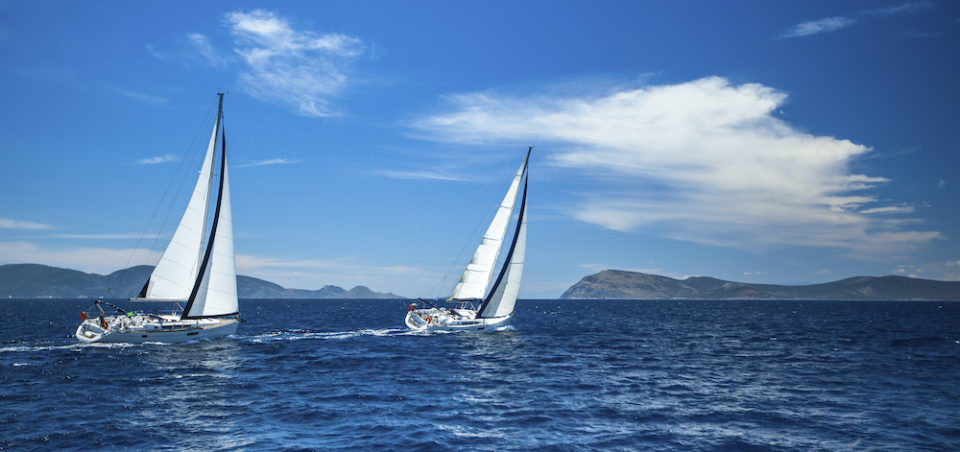
First, realize it’s not change that controls what happens to us or where we end up; it’s how we manage ourselves in the midst of change that makes the difference. No sailor can manage the wind, but even a novice sailor learns to manage the set of the sails to take full advantage of the wind. It’s not the wind that brings a ship to its destination; it’s the set of the sails and the skill of the sailor in harnessing the wind. Poet Ella Wheeler Wilcox wrote (“Tis the Set of the Sail,” from World Voices, by Ella Wheeler Wilcox, 1916):
“One ship sails East,
And another West,
By the self-same winds that blow,
‘Tis the set of the sails
And not the gales,
That tells the way we go.
Like the winds of the sea
Are the waves of time,
As we journey along through life,
‘Tis the set of the soul,
That determines the goal,
And not the calm or the strife.”
It’s not the winds of change that determine our future or define our destination; it’s the way we orient ourselves to change that makes the difference. And when we embrace change creatively, a richer life is possible.
And second, like every boat needs a deep keel to keep her steady in rough seas, we need our own deep keel to keep us steady in the sea of change. We need to keep our heads and remember who we are, even when – or especially when – no one else does. In the words of St. Peter, “[we] are the ones chosen by God, chosen for the high calling of priestly work, chosen to be a holy people, God’s instruments to do his work and speak out for him, to tell others of the night-and-day difference he made for [us]” (1 Pet. 2:9 The Message).
We need to be able to answer Thomas Merton’s defining question: what are you living for, in detail, and what keeps you from living fully for the thing you want to live for? And having answered Merton’s question, we need to keep that thing before us. We need to keep before us the thing we’re living for and be aware of whatever keeps us from living fully for that thing. As Stephen Covey wrote in First Things First: in living, ”the main thing is to keep the main thing the main thing.” Be sure every decision, every choice, is made with the thing you’re living for clearly in mind.
Change is coming, and indeed it already has a hold on us. Sometimes it’s going to come faster than we expect and grab us by the suspenders as it races by. When we say, as Peter did, “This must never happen,” we place ourselves directly in opposition to the new thing God is doing. How much better it is if we remember who we are, a people chosen by God for a holy purpose, and focus on how to orient ourselves to change creatively so that it continues to bring God’s grace directly into our laps as a blessing to us and to others.

 The Sauntering Pilgrim
Leave a comment