
Earlier this year, many of you shared with me your greatest hope. One of you said it was to give the best of yourself to those in need. For another, it was that your daughters “live a happy life by following their hearts.” Someone’s hope was “release from injustices and abuse,” and for another it was “to reside with God eternally after life on earth is over.” Or it was for peace and all it includes: fullness of life, healing, reconciliation and harmony among differences, an end of violence, joy and love for all. Do you recall what your greatest hope was, or what it is today?
We have two favorite symbols of our hope. One is the garden of Eden (Gen. 2:8-9), the perfect way life was before it was blemished and spoiled, before brokenness and suffering and death entered the picture, before we experienced mourning and crying and pain. Another is the new Jerusalem coming down out of heaven from God, the perfect way life will be one day, when every tear will be wiped away, when death and mourning and crying and pain will be no more (Rev. 21:2-4).
But the garden of Eden and the new Jerusalem exist only in our imagination. The scriptures offer what I believe is a better symbol, and that’s the table God prepares for us today, in the presence of our enemies, amid all our troubles, where we are anointed with oil and our cup overflows (Ps. 23:5). It’s the wedding feast where ordinary water suddenly becomes the best wine and everyone has a share (John 2:1-11); the holy feast where thirsty people come to the waters and those who have no money buy wine and milk without money and without price (Isa. 55:1); the wilderness where we are hungry and by God’s grace are fed, with an abundance left over (Matt. 14:15-21).
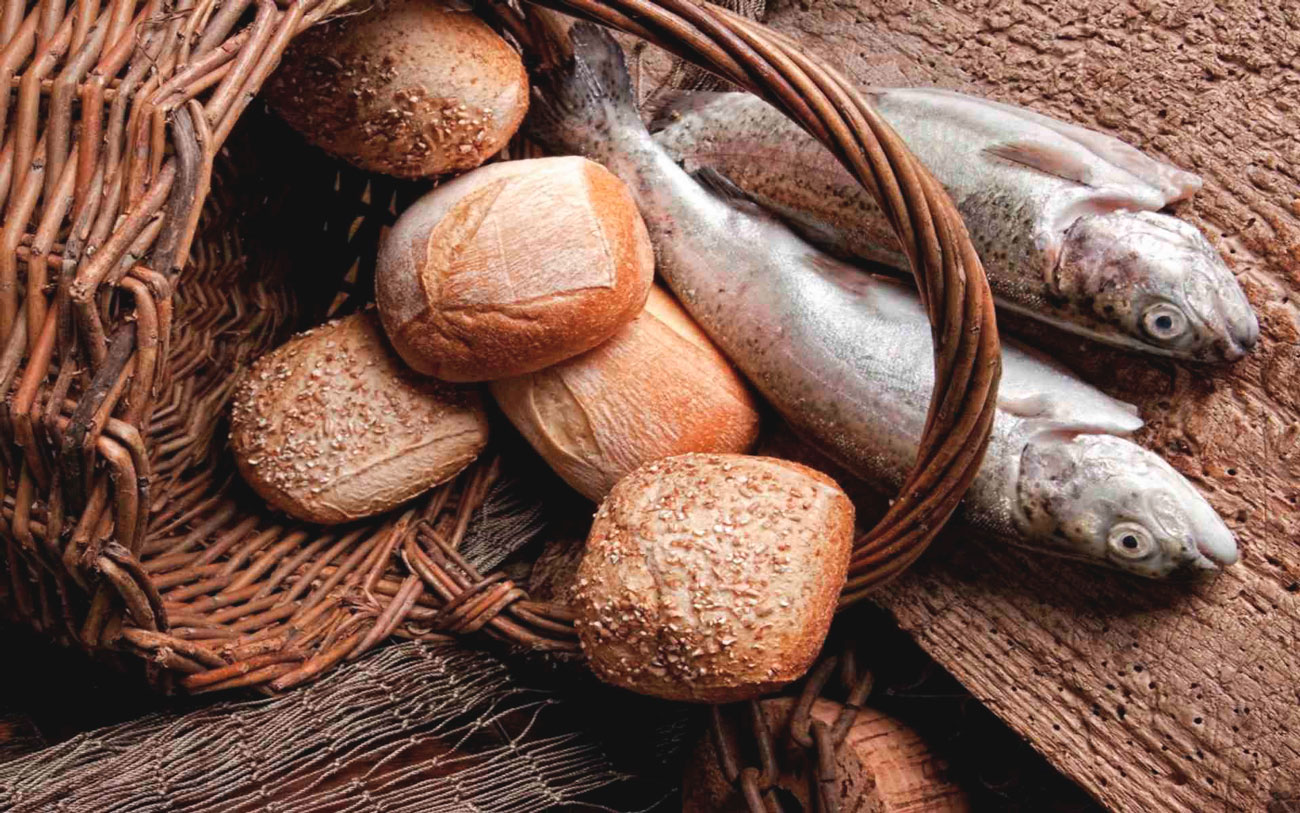
The only miracle of Jesus to appear in all four gospels is the feeding of the multitude, and it’s so important it’s told six times. The symbol appears twice more in the parable of the great banquet (Matt. 22:1-10; Luke 14:15-24), again in the wedding feast at Cana, and many other times in stories of Jesus’ eating with misfits and outcasts as well as with the powerful and influential.
It’s worth our attention because we are hungry, and people around us are hungry. Some are hungry for food, for shelter, for safety, for relief from illness; some hunger for freedom from physical or social limitations or the heavy burdens of mind and heart; some hunger for purpose and meaning in life. Joseph Campbell believed that what we’re really hungry for is “an experience of being alive, so that we actually feel the rapture of being alive.” That’s what Jesus said he came to offer: abundant life; a rich and satisfying life; life in all its fullness; more and better life than you ever dreamed of (John 10:10).
It’s what Israel sought when they walked away from captivity in Egypt. It’s what Simon and Andrew left their nets and families to find (Mark 1:16-20). It’s why Matthew left his job as a tax collector (Matt. 9:9). It’s what Nicodemus sought when he came to question Jesus by night (John 3:1-10). It’s hidden in the greatest hopes you expressed in the survey you completed earlier this year. It’s wrapped up in why you’re here this morning, and in your desire to connect with the community around you, and in the deliberate, faithful search for your next pastor.
That life can seem as elusive as it is desirable, so it’s important to remember that the fulfillment of that promise of life is the very essence of the gospel Jesus proclaimed: your waiting is over, and your hope is at hand. Like God fed Israel with manna in the wilderness, through the risen Christ God continues to feed us with the bread of heaven and the cup of life. When the disciples asked Jesus to feed the hungry crowd, he did so, but he did so with resources they already had in hand. “You give them something to eat,” he said (Matt. 14:16). And he took what they had, and it was enough for all. All the pieces of the picture of abundant life are already at hand. We have only to put them together with the guidance of Christ.
The church has been losing members and influence for decades, and now for the first time ever, we’re a minority in this country. Researchers point to obvious reasons: Christians, it seems, are more concerned about judging others than about repenting and changing ourselves; we love to argue and fight over the proper faith about Jesus but are poor at embodying the faith of Jesus; we’re more concerned about recruiting members and securing our congregations than we are about giving ourselves up for the transformation of the world;.
But one especially telling reason is emerging. A new book, The Great Dechurching, based on work by political scientists at Eastern Illinois University and Denison University, suggests that American churches have been so caught up in the lifestyle of the world around us that we now have nothing to offer to hungry, suffering people that can’t be more easily found somewhere else. In other words, we’ve become just another social club, and not a very effective one at that.
The great “dechurching” the book addresses doesn’t need to be bad news. It could be the beginning of a new moment for us, marked less by respectability and success and more by the emergence of true community, the kind people are hungry for, the kind that offers an experience of the rapture of being alive, the kind that has the power to transform a broken, hurting, hungry world.
The elements of that new community are already in our hands. In the coming weeks I’ll be reflecting with you on the nature of that community, on how we can strengthen the elements of it that are already in place, and on how we might build it into something still more inclusive, still more enriching of life, and still more transforming.
In the meantime, remember that the reason we are part of the body of the risen Christ is to be good stewards of the good news that the banquet of heaven has begun and to embody that good news daily. We’re called to savor it here and now and to share it with others who also hunger for it, satisfying not merely the hungers that come and go, but the deep, essential, abiding hungers of the human experience. We’re doing that here at Holy Trinity, and in the coming weeks, I’ll reflect with you on how our hunger and that of our neighbors is being satisfied, how abundant life is spread all around us ready for the taking.
More about that later. For now, and for the coming week, I invite you to reflect deeply about what you’re really hungry for, not the trendy cravings but the deep hungers that bind you to God, the human hungers we all share and that make us one with each other and with the whole human family. What are you really and deeply hungry for in life? ▪

 The Sauntering Pilgrim
Leave a comment